Introduction
In this course, students will engage in independent research projects. The projects will be agreed upon in mutual understanding between student and instructor. Projects will relate to adaptation to the impacts of the syndrom of modern global change. Of particular importance will be the challenges modern changes in the biosphere, humansphere, and technosphere pose to conservation efforts. Understanding these challenges requires systems thinking and a transdisciplinary approach to the wicked problems society is faced with.
The challenge of adapting to the current and future changes inflicted by humanity on the planet and the Earth's life-support system poses many “wicked problems to society. Almost all sustainability issues pose wicked problems to society. For wicked problems there is no general agreement between stakeholders on the description of the problem, each of these problems is unique, there is no set of solutions, and there is no point when the problem is solved. Often, time is running out, those who aim to solve the problem are part of the problem, there is no central authority to take care of the problem, and there is a strong tendency to focus on short-term benefits and to discount the more distant future. Coming up with a transformative set of interventions that have the potential to lead to a desirable future requires a deep understanding of the relevant system.
No comprehensive theory exists on how to address wicked problems, but most of them have to be addressed in transdisciplinary approaches. Addressing such problems requires environmental, social, and economic considerations in a complex systems environment. Therefore, we will approach any specific problem by first describing the problem in its many facets and then pulling in theory and expertise where needed to better understand the problem and to illustrate possible approaches to address the challenges.
|
Announcements
Case Studies of Wicked Problems
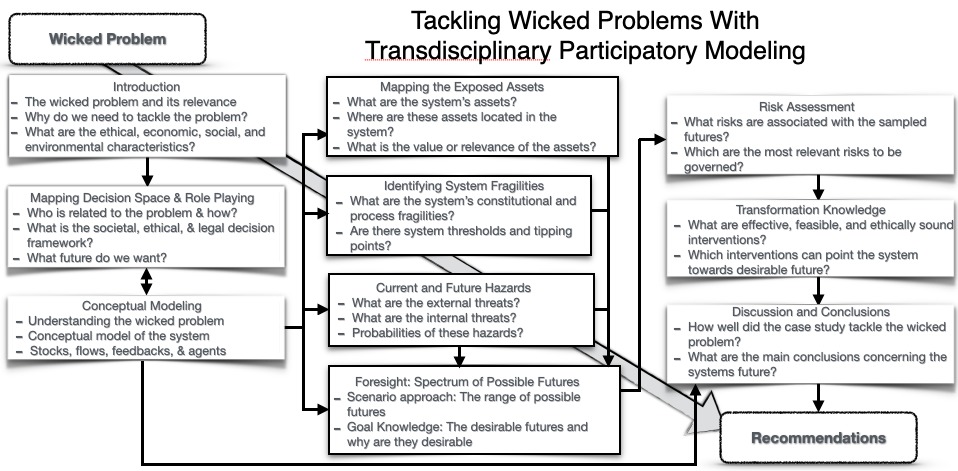
The learning experience in the class will come from case studies of wicked problems related to the threats of modern global change. The MARI template for case studies will be used for each of the case studies (see the figure below). The goal of the research in each case study of a wicked problem is to develop a set of recommendations for interventions that could facilitate progress towards an agreed-upon desirable future. In the research projects, the case study template will be used to address the problem of mitigating modern global changes and adapting to the many impacts. In indivdiual case studies, each student will use the template to research a wicked problem.
For each problem, there is an underlying system that can be conceptualized and modelled. The template underlines the importance of modeling for the understanding of the current and future system trajectories and the development of viable options will be emphasized. The opportunities and limitations for mitigation and adaptation interventions result to a large extent from societal decision making processes and the general basis of human decision making, which requires a deep understanding of the decision space. Importantly, decision and policy making needs to be informed by foresight comprising the full spectrum of possible futures of the system under consideration. The system is exposed to hazards, and many of these hazards are resulting from the on-going planetary reengineering that is pushing the planet out of the Holocene. Understanding the probability density function of these hazards is a prerequisite for developing foresight. Knowing the vulnerability to these hazards of the integrated socio-ecological and economic system of system associated with each wicked problem provides a basis for risk assessments to these hazards. Combining systems knowledge with reasonable scenarios for societal and environmental developments provides the means to explore the spectrum of possible futures and can help to develop the needed foresight. Based on that, interventions that have the potential to put the system on a trajectory towards a desirable future can be identified, and recommendations can be made.
The Class Workspace
The class workspace provides access to many collaboration tools and all tools required for assignments. The "Stay Woke" page provides tools for the students to communicate and work together. Among others, questions can be asks to everybody, topics can be discussed, material can be shared, and important statements can be pinned. And everybody can comment on any of the entries made there.
|